


Clearing high-interest debt with home equity often comes down to a single question: do you need a structured, one-time lump sum or ongoing access to funds? Homeowners frequently ask us to compare mortgage debt consolidation against a home equity line of credit (HELOC), because both use your property to secure better terms than credit cards or unsecured loans. The right answer depends less on which product sounds better and more on your repayment habits, cash flow, and how much debt you actually need to clear.
In this guide, we walk through how each option works, the key differences, the risks, and a practical decision framework. By the end, you will understand whether a fixed mortgage consolidation or a variable HELOC better fits your situation, without needing to guess.
Understanding Debt Consolidation and Home Equity
What is Debt Consolidation?
Debt consolidation means taking multiple debts—credit cards, personal loans, store cards—and combining them into one obligation. The goal is almost always to reduce the interest rate and simplify monthly payments. Instead of three or four minimum payments with different due dates, you make one payment. That alone can reduce late-payment risk, but the real saving comes from replacing high-rate unsecured debt with a lower-rate secured product.
How Home Equity Can Be Used to Consolidate Debt
Home equity is the difference between your home’s market value and what you still owe on any mortgages or liens. If your home is worth $600,000 and you owe $300,000 on the mortgage, you have $300,000 in equity. Lenders allow you to borrow against a portion of that equity—usually up to a regulated maximum—and use the funds to pay off other debts. Two common ways to access that equity for consolidation are a home equity line of credit (HELOC) and a mortgage refinance or second mortgage.
Benefits and Risks of Using Home Equity
The main benefit is lower interest rates than unsecured credit, which can dramatically reduce the interest you pay each month and over time. Consolidating into one payment also simplifies budgeting. The trade-off is that you are converting unsecured debt into secured debt. Your home becomes collateral, and if you fail to repay the new loan, the lender can take legal action to recover the property. You also reduce your equity cushion, which can limit future options like selling or further borrowing.
How a Home Equity Line of Credit (HELOC) Works for Debt Consolidation
What is a HELOC and How Does It Work?
A HELOC is a revolving credit product secured by your home. You are approved for a maximum credit limit based on your equity, and you can draw funds as needed, repay them, and borrow again up to that limit during the draw period. Unlike a term loan, you do not receive the money all at once. Interest accrues only on the amount you have actually drawn, not on the full credit limit.
Using a HELOC to Pay Off Debts
To consolidate with a HELOC, you draw enough funds to pay off your outstanding credit card balances, personal loans, and other high-interest debts. Those accounts are cleared, and you now owe the HELOC instead. Because HELOC interest rates are typically much lower than credit card rates, the interest you pay each month drops. However, you must then actively pay down the HELOC balance; otherwise, the debt remains indefinitely, especially if you only make minimum interest payments.
HELOC Terms and Features
Most HELOCs have variable interest rates tied to a lender’s prime rate plus a margin. Payments are often interest-only, meaning you are required to pay only the interest each month, though you can pay more. The credit limit stays available, and as you repay principal, that amount becomes available to borrow again. This revolving structure is both the biggest advantage and the biggest risk of a HELOC.
How Mortgage Debt Consolidation Works: Refinancing and Second Mortgages
Refinancing Your Mortgage for Debt Consolidation
Refinancing means breaking your existing mortgage early and replacing it with a new, larger mortgage. The new mortgage pays off the old one and provides extra cash, which you use to clear other debts. You then have a single mortgage payment that includes the consolidation amount. The new mortgage has its own term, interest rate (fixed or variable), and amortization schedule, giving you a clear end date if you follow the payment schedule.
Second Mortgages and Home Equity Loans
Instead of refinancing the first mortgage, you can take out a second mortgage or home equity loan. This is a separate lump-sum loan secured by the same property, sitting behind the first mortgage. You receive the full amount at closing and repay it on a fixed schedule, often with a fixed interest rate. The total borrowing across both mortgages cannot exceed the lender’s maximum loan-to-value limit, typically 80% of the home’s appraised value for federally regulated lenders.
The Process of Getting a Lump Sum
To consolidate through a mortgage, you first meet with a lender or broker to assess your equity, income, and credit. The lender orders a home appraisal to confirm current value, then underwrites the new loan. Once approved, the funds are advanced at closing: the old mortgage is paid out, other debts are paid directly or you receive the excess to pay them yourself, and you start making payments on the new mortgage according to the schedule.

Key Differences Between HELOC and Mortgage Debt Consolidation
Credit Type: Revolving vs Lump Sum
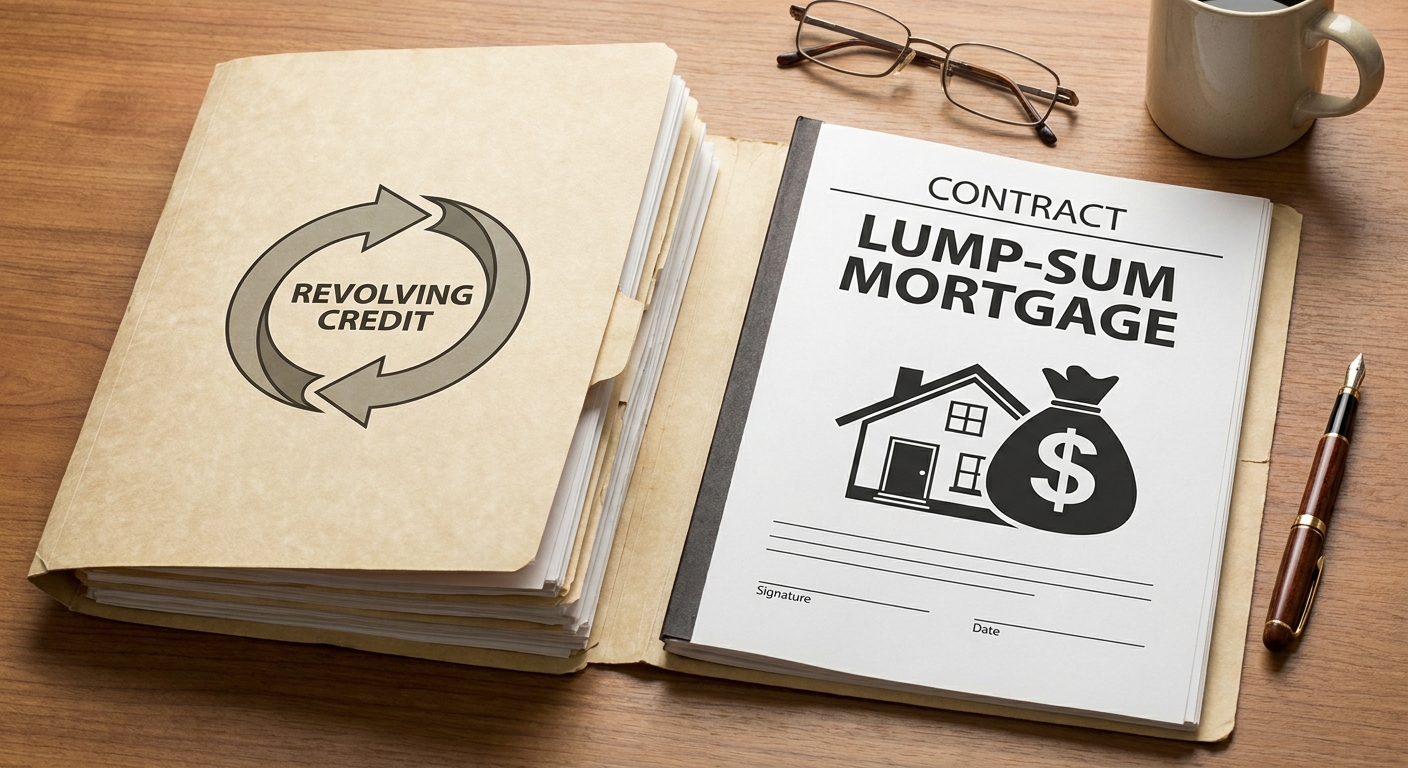
The most fundamental difference is the type of credit. A HELOC is revolving: you have a credit limit, and as you repay, you can re-borrow. A mortgage consolidation (whether first mortgage refinance or second mortgage) is a term loan: you receive a fixed amount once, and as you pay it down, you cannot re-borrow without applying again.
Repayment Structure
A HELOC usually requires only interest payments each month, with principal repayment optional. This keeps the minimum payment low but can leave the balance untouched for years. A mortgage consolidation has a fixed amortization schedule with principal and interest in every payment, so the debt is systematically paid off by the end of the term if you stay on schedule.
Interest Rate Differences
A HELOC typically carries a variable rate that moves with the prime rate, so your monthly interest charge can rise or fall. Mortgage consolidation can be fixed, locking in the rate for the term, or variable/adjustable depending on your choice. Fixed mortgage rates are often lower than the HELOC’s variable rate at any given time, but that is not guaranteed. The key difference is predictability versus potential savings if rates fall.
Borrowing Limits and Equity Access
Federally regulated lenders cap a HELOC at 65% of the home’s lending value, and that limit must be reduced by any outstanding mortgage balance. A mortgage refinance or second mortgage can take total borrowing (first mortgage plus any second) up to 80% of the home’s value. That means a mortgage consolidation often lets you access more equity than a standalone HELOC if you have a large existing mortgage.
Interest Rate Structures: Fixed vs Variable and the Impact on Your Payments
Variable Rates on HELOCs
A HELOC’s rate is usually expressed as prime plus a margin, such as prime plus 0.5% or prime plus 1%. When the central bank changes its policy rate, prime changes, and your HELOC rate follows within days. Your required interest payment adjusts with the balance and the rate, so your monthly obligation can fluctuate even if you do not borrow more.
Fixed Rates on Mortgage Consolidation
With a fixed-rate mortgage consolidation, the interest rate is locked for the term, whether 2, 3, 5, or more years. Your payment stays the same throughout the term, making budgeting easy. You give up the chance to benefit from falling rates, but you eliminate the risk of rising rates. This is often the safer choice for borrowers who want certainty while clearing debt.
How Rate Changes Affect Your Debt Repayment
If rates rise, a HELOC balance becomes more expensive, and if you only make minimum interest payments, the principal never decreases, so you pay more interest over time. A fixed mortgage payment already includes principal, so even if rates were to rise later, your payment during the term remains unchanged. If rates fall, a variable HELOC could become cheaper, but you must weigh that potential against the risk of rate increases.
Repayment Flexibility: Revolving Credit vs Lump Sum
HELOC Flexibility and Interest-Only Payments
A HELOC gives you maximum flexibility. You can pay only interest during tight months, make large lump-sum payments when cash is available, and even re-borrow if an emergency arises. This flexibility is valuable for homeowners with irregular income or ongoing expenses, but it requires discipline to avoid leaving the balance stagnant.
Mortgage Consolidation Fixed Payments
A mortgage consolidation builds repayment into the product itself. Every payment includes principal and interest, and the amortization schedule guarantees the debt is retired by the maturity date if you make all payments. This forced savings element helps many borrowers actually clear debt rather than just moving it.
Managing Cash Flow with Each Option
If you have a stable salary and want to be debt-free on a timeline, a mortgage consolidation’s fixed payment is easier to automate and plan around. If your income is commission-based or seasonal, a HELOC’s lower minimum payment can provide breathing room, but you must commit to paying extra when you can. We often suggest setting a personal payment schedule for a HELOC that mirrors an amortization period to avoid perpetual debt.

Risk Assessment: Collateral, Foreclosure, and the Danger of Running Up New Debt
Your Home as Collateral
Both a HELOC and a mortgage consolidation use your home as security. That is why you get a lower rate than unsecured credit, but it also means the consequences of default are severe. If you stop making payments, the lender can begin legal proceedings and ultimately force the sale of your home to recover the debt. This risk exists regardless of how small the borrowed amount is relative to equity.
Foreclosure Risk
Foreclosure is the worst-case scenario. It can happen if you miss multiple payments on either product. The risk is higher if you already have high total debt and reduce your equity with a consolidation loan, leaving little buffer if home values fall or income drops. Even if you have never missed a payment, the possibility of future financial stress should be weighed carefully.
The Temptation of Revolving Credit
A HELOC’s biggest behavioral risk is the ability to re-borrow. After paying off credit cards with the HELOC, many people start using those cards again, effectively doubling their debt. The open credit line becomes a safety net that turns into a trap. Mortgage consolidation eliminates this temptation because the funds are advanced once and the line is closed or reduced.
Mitigating Risks
Regardless of which product you choose, you can reduce risk by closing paid-off credit cards or cutting up cards, building an emergency fund, choosing a repayment amount above the minimum, and avoiding new consumer debt until the consolidation is paid down. Setting a firm payoff date—even for a HELOC—creates accountability.
Qualification Requirements and Canadian Lending Regulations
Lending Limits: 80% and 65% Rules
For federally regulated lenders, the maximum combined loan-to-value (LTV) when refinancing a mortgage or taking a second mortgage is 80% of the home’s appraised value. A HELOC alone is capped at 65% LTV, and if you have an existing mortgage, the HELOC plus mortgage cannot exceed 65% of the home’s value for the HELOC portion. In practice, a readvanceable mortgage product can allow total borrowing up to 80%, but the revolving portion is limited to 65%.
Stress Test Requirements
To qualify for a HELOC or a mortgage refinance at a federally regulated financial institution, you must pass the mortgage stress test. That means the lender checks whether you can afford payments at a higher qualifying rate—often the contract rate plus 2% or a floor rate, whichever is greater. Even if you are consolidating to lower your monthly payment, the stress test uses a higher rate, so your income and existing debt service ratios must support that higher payment.
Credit and Income Requirements
Lenders review your credit score, income stability, and total debt service (TDS) and gross debt service (GDS) ratios. A history of missed payments may make approval harder, but a strong equity position can help. Some lenders may have more flexible programs for borrowers with bruised credit, especially if the consolidation significantly reduces monthly obligations.
We work with more than 300 lenders, which lets us compare consolidation structures across a wide range of products. This access helps us match borrowers with a lender whose terms fit their specific repayment goals.
Pros and Cons of Using a HELOC for Debt Consolidation
Advantages of a HELOC
- Lower interest rate than most credit cards and unsecured loans
- Interest charged only on the amount you draw, not the full limit
- Flexible repayment: you can pay only interest or make principal payments any time
- Ongoing access to credit for emergencies or future needs
Disadvantages of a HELOC
- Variable interest rate can rise, increasing your payment
- Interest-only minimum payments can leave the balance unchanged for years
- Revolving access may tempt you to re-borrow and run up new debt
- Your home is collateral, exposing you to foreclosure risk
When a HELOC Makes Sense
A HELOC is often appropriate when you have strong financial discipline, a smaller debt amount that you can pay off within a few years, or irregular cash flow that benefits from low minimum payments. If you are confident you will aggressively pay down the balance and not re-borrow, the flexibility can save interest and give you an emergency buffer.
Pros and Cons of Mortgage Debt Consolidation for Clearing Debt
Advantages of Mortgage Consolidation
- Fixed interest rate option locks in predictable payments
- Principal is included in every payment, so the debt is amortized and eventually paid off
- Single monthly payment at a lower rate than credit cards
- No revolving credit line to re-borrow, reducing overspending risk
Disadvantages of Mortgage Consolidation
- Less flexibility: you cannot re-borrow or skip principal payments without refinancing again
- Refinancing may extend the debt over a longer amortization, potentially increasing total interest even at a lower rate
- Refinancing requires a new application and home appraisal, adding steps before you receive funds
When Mortgage Consolidation is the Better Choice
Mortgage consolidation is usually better when you have a large, one-time debt amount, want a fixed payment you can set and forget, and prefer the structure of a term loan over a revolving credit line. If the risk of re-borrowing is high or you struggle to maintain extra payments, the forced amortization of a mortgage will actually get you out of debt.

Decision Guide: When to Choose a HELOC vs Mortgage Debt Consolidation
Assessing Your Debt Amount and Financial Situation
Start by listing every debt, its balance, interest rate, and minimum payment. Compare the total to your available home equity. If your debt is small relative to equity and income, a HELOC may offer enough savings with more flexibility. If the debt is large and you need to clear it in one stroke, mortgage consolidation provides the lump sum and structured payoff.
Considering Your Financial Discipline
Be honest about your past behavior with credit. If you have paid off cards before only to run them up again, a HELOC’s revolving access is dangerous. The closed-end nature of a mortgage consolidation removes that temptation. If you are disciplined and have a track record of paying extra, a HELOC can be a powerful tool.
Aligning with Long-Term Goals
Think about whether you plan to sell the home soon, whether you expect income changes, and how close you are to retirement. A fixed mortgage payment may be easier to sustain on a fixed retirement income, while a HELOC’s low minimum could help if you expect variable income but can pay it off before retirement.
Questions to Ask Yourself
- How much total debt do I need to consolidate, and over what timeline can I realistically repay it?
- Can I handle rising interest rates on a variable HELOC, or do I need the certainty of a fixed mortgage rate?
- If I use a HELOC, will I be tempted to use the credit line again for non-essentials?
- Will the consolidation actually reduce my total monthly payments enough to improve cash flow, or just move debt around?
- What happens if my income drops or home values fall—do I have enough equity and emergency savings to manage?
The Role of Credit Counseling and Professional Advice in Your Decision
Why Seek Professional Advice
Borrowing against home equity is a significant financial decision with long-term consequences. An independent mortgage professional can calculate exactly how much you can borrow, what the new payments will be, and whether the consolidation truly saves you money after accounting for any refinancing steps. A credit counselor can help you build a budget that prevents a return to high-interest debt.
How Credit Counselors Can Help
A non-profit credit counselor reviews your entire financial picture—income, expenses, debts, and assets—and helps you evaluate whether home equity consolidation is appropriate. They may identify alternatives like a debt management plan or budgeting adjustments that do not put your home at risk. They also help you understand the impact on your credit score and future borrowing ability.
Finding the Right Advisor
Look for a licensed mortgage broker or agent who can access multiple lenders and explain both HELOC and mortgage consolidation options without pushing one product. For independent guidance, seek an accredited non-profit credit counseling agency. Ask pointed questions about interest rate assumptions, repayment schedules, and what happens if rates rise or income falls.
If you are weighing mortgage debt consolidation against a HELOC and want a clear comparison based on your actual equity and repayment comfort, reach out for a strategy session. We will help you run the numbers and decide which path fits your situation before you commit.